Showing posts with label Book reviews. Show all posts

Sunday, January 11, 2026

Home Fires

Anyone under 40 might have trouble understanding how progressive the comedy-drama Room 222 (ABC, 1969-74) was on late sixties TV. Its opening titles (complete with one of TV’s loveliest musical themes) tell the story without saying a word. We see dozens of kids walking along outside an urban high school, chatting and interacting; they are an easy, natural-looking mix of faces, some white, many not. Next comes our top-billed star, an African-American man, a teacher. He smiles at the sight (who wouldn’t?) of his colleague, played by someone I’ve long considered one of TV’s most beautiful women, Denise Nicholas. What followed was a show that dealt with themes — drug addiction, homophobia — little explored on home screens then suffused with the likes of Petticoat Junction and The Brady Bunch, yet one that also made us smile as we grew to know and like the faculty and students of Walt Whitman High.

Decades later, her lead role as school counselor Liz McIntyre is probably what many people most associate with Ms. Nicholas. But her recently released book, Finding Home: A Memoir (Agate) offers a welcome opportunity to know her better. This is not your typical “and then I starred in” actor’s autobiography. Though saddled with a regrettably generic title, it’s a gracefully written, candid account of a life many of us can find relatable and sympathetic. Achieving a major breakthrough with Room 222, she strove to parlay it into film work, but her elegant beauty wasn’t cut out for the blaxploitation films of that era. (She also stayed true to her father’s stern admonition, “Do not let me walk into a movie theater and see your naked ass up on that screen.”)

As she grew older, she began to shift her interests from acting to writing, eventually publishing a critically acclaimed novel, Freshwater Road. She writes warmly of the late Carroll O’Connor, who made her his leading lady on In the Heat of the Night (NBC, CBS, 1988-95), and helped her gain multiple screenplay credits on the show. Away from the cameras, she writes frankly about three marriages that ended in divorce, and the unsolved murder of her sister.

Now in her eighties, rather than sinking into a relaxing retirement, she’s providing hands-on caregiving to her mother, more than 100 years old, who suffers from dementia. As she openly admits, she can’t afford full-time care in a place to which she could comfortably entrust a cherished family member. It’s that sort of confession that made this book resonate with me. Like most of us, Ms. Nicholas has worked hard to build a successful career and happy home life. Sometimes she’s succeeded, sometimes she hasn’t. I came away from this book feeling I’d truly gotten to know another human being better. Having long admired her work, I now add to that my respect for her humanity.

Monday, January 13, 2025

“Another Wonderful Book”

The always-interesting “Another Old Movie Blog,” hosted by Jacqueline T. Lynch, is shining a spotlight on my book, John Hodiak: The Life on Film, Stage and Radio. Am I glad she did!

This post’s title is blatantly cribbed from her review. She mentions not only Hodiak’s film career, but his work on radio, which the book covers in detail. Ms. Lynch believes he deserved a higher level of fame than he achieved prior to his early demise, and I certainly concur.

To read her review in its entirety, go here.

While you’re there, become a subscriber, and check out her fine books. You’ll be glad you did.

P.S. I’m hard at work on a new book project. Stay tuned. I hope to share some details soon.

Thursday, October 10, 2024

The Reviews Are In!

No, it’s not like one of those movie scenes where the cast and crew of a Broadway play sit nervously at Sardi’s late on opening night, waiting for the newspaper critics to publish their reviews. But I think most authors would admit there’s a little anxiety felt when your book makes its debut in the world, and you wait to hear how critics and readers react.

So, that being said, are you ready to read the first published review of John Hodiak: The Life and Career on Film, Stage and Radio? Here it is, courtesy of noted film biographer Derek Sculthorpe. 

Want a second opinion? My fellow author Stephen Michael Shearer has contributed the inaugural Amazon review, which says in part, “David C. Tucker has written an excellent biography … followed by a well-researched and valuable critical history of all (Hodiak’s) films, stage and radio appearances … As he accomplished with his fascinating books on actress Rochelle Hudson, and director S. Sylvan Simon, Tucker has given us another well-deserved and valuable biography which every film buff and scholar should read.”

While critical plaudits are greatly appreciated, I enjoy hearing from readers, too. So if you like the book, I hope you’ll let me know. Mr. Hodiak deserves the recognition, don’t you think?

Tuesday, May 14, 2024

Noir Star

As I’ve mentioned before, I believe there are certain iconic Hollywood figures who have already been the subject of enough books, if not too many. (Hello, Marilyn Monroe!) But as author David Meuel makes a point of saying up front, his new book Joan Crawford in Film Noir: The Actress as Auteur (McFarland) is not a biography. That’s especially welcome for an actress whose private life — or, perhaps I should say, gossip about it — has too often overshadowed serious discussions of her work.

As Meuel states, by examining Crawford’s noir-tinged films of the 1940s and 1950s, his book helps readers appreciate “what she aspired to achieve in her art,” and “why the best of her efforts speak to us across the decades with such intensity and authority.” Naturally, any such discussion includes her Oscar-winning performance in Mildred Pierce (1945), but the author also makes room for extensive, thoughtful coverage of Daisy Kenyon (1947), A Woman’s Face (1941), and a personal favorite of mine, Autumn Leaves (1956). 

When the film, like This Woman is Dangerous (1952), falls well short of brilliance, he says so, but not without pausing to consider what elements of it do work. All told, twelve films receive in-depth coverage. I also appreciated his inclusion of two little-known dramas starring Crawford, seen on television’s General Electric Theater (1953-62), which contain clear noir elements. His comments make me eager to see them. 

Meuel readily acknowledges that movie buffs often find the actress’ later efforts like Female on the Beach and Queen Bee (1955) “films they’ll see to hoot and howl at.” But his essay about them poses an interesting quandary: “Why would Crawford … settle for bad scripts” and “play these roles with such scene-chewing relish?” The text that follows is intriguing.

If you’re a longtime Crawford fan (as I am), or a devotee of noir, like so many classic film fans, this book is well worthy of your attention. The carefully chosen film stills are a welcome bonus.

Monday, April 8, 2024

Silents, Please

Lon Davis has spent most of his life as a movie buff, with a particular fondness for silent film. He has written several fine books on motion picture history — including the recent Ma and Pa Kettle on Film— often in collaboration with his wife Debra. With Stumbling Into Film History (BearManor Media), he now gives us an engaging collection of essays that not only cover some of his favorite performers, but also serve as a memoir of sorts. 

The opening chapter gives us a vivid portrait of silent film star Beverly Bayne, whom the author met as a teenager. His depiction of her as “alternately charming and imperious, and given to sudden bursts of volatility” is intriguing. I also liked the chapter on Diana Serra Cary (“Baby Peggy”), which provides a detailed account of her career as a child star, but is enriched by Davis’ memories of their longtime friendship. Another strong essay lets us get better acquainted with film historian Kevin Brownlow, author of the seminal work The Parade’s Gone By. 

This melding of the personal and the professional, of movie icons and the fans who love them, makes for an engaging book. It’s hard to imagine that anyone who shares Davis’ happy addiction to movie lore wouldn’t enjoy it. I certainly did.

NOTE: I was furnished a free copy of this book in exchange for an honest review.

Monday, July 17, 2023

Soldier’s Story

Twenty-five years after its release, Paul W.S. Anderson’s Soldier (1998) is a film that, despite its initial mixed reception, has acquired a cult following. Now, thanks to author Danny Stewart’s Soldier: From Script to Screen (BearManor Media) readers who appreciate it — or want to better understand it  — can learn quite a bit about the creation and production of what Stewart describes as “part military movie, part Western, and part outsider allegory.”

The heart and meat of this book are Stewart’s interviews with more than a dozen film professionals who worked on the project, notably screenwriter David Webb Peoples. They are presented much in the style of Tom Weaver’s acclaimed books on older sci-fi and horror films, allowing us to hear the interviewees’ voices even from the printed page. While one or two of them have little of interest to say, on the whole they provide a substantial amount of behind-the-scenes information of the kind that warms a film buff’s heart. Wouldn’t it be wonderful if someone had done this with so many classic films while the opportunity was there? Stewart deserves kudos for capturing this information in a timely way; the clock of motion picture history is always ticking away, more rapidly than we realize. 

Though it’s clear the author greatly admires the film, he allows other opinions to be aired. The always-welcome and astute John Kenneth Muir contributes a review that ably assesses what works — and what doesn’t — about Soldier. Stewart also explores the ways in which Soldier intersects with Blade Runner.

This book was clearly a labor of love for its author. Those who share his regard for Soldier will read it with pleasure and gratitude.

NOTE: I was given a free e-copy of this book in exchange for an honest review.

Sunday, July 9, 2023

“The Review is In!”

Color me flattered by veteran film historian James L. Neibaur’s recent review of Rochelle Hudson: A Biography and Career Record. Jim calls it “an interesting, enlightening, and impressive portrait of both the person and the actress,” one that “gives us a truly thorough understanding of Hudson’s screen career as well as her life.” He adds that it’s “highly recommended for libraries, research centers, and fans of classic Hollywood.” (Are you listening, librarians, archivists, and readers?)

You can read the review in its entirety here. While you’re there, check out the impressive list of film books Jim has published over the course of a noteworthy career.

Tuesday, June 27, 2023

Snow Job

For savvy horror and sci-fi fans, the name Bryan Senn on a book cover has long been a reliable indicator of an authoritative, enjoyable read. Now Senn expands his horizons a bit with Ski Films: A Comprehensive Guide (McFarland), covering a sport which his usual readers may not know is another of the author’s longtime passions.

Would you be surprised that this winter sport has figured into enough movies to fill a 400-plus page volume? I was. Off the top of my head, I came up with Downhill Racer (1969) and Aspen Extreme (1993), and, in an earlier era, the musicals of Sonja Henie. But in this book, similar in format to his The Werewolf Filmography, published a couple of years ago, Senn provides a comprehensive overview of films covering a century of filmmaking. Each film is evaluated both for its overall merits (or lack thereof) as well as comments on its depiction of skiing. 

At times, you’ll be glad Senn sat through these movies, so you don’t have to. He awards the apple for “absolutely the stupidest ski scene” to xXx (2002) for “a five-minute snowboarding sequence that must be seen to be disbelieved,” while making mention of “charmless” Vin Diesel’s “bland expressions and blah delivery.” Coming in for more affirmative coverage is the aforementioned Downhill Racer, which scores well on both the “Cinematic” and “Ski-Matic” ratings that the author assigns to each film. 

Useful appendices provide a handy guide to ski movie tropes (such as avalanches), a chronological listing of films covered, and a best-to-worst ranking (including the author’s Top Ten ski films). Whether you read cover-to-cover or browse, this is a fun book, one that amply displays Senn’s gifts for both research and readability.

NOTE: I was furnished a free e-copy of this book in exchange for an honest review.

Thursday, May 11, 2023

Hurrah for Meuel

David Meuel’s Silent Film’s Last Hurrah: The Remarkable Movies of the Long 1928 (McFarland) takes an overview of film during a period stretching from the groundbreaking release of The Jazz Singer in October 1927 through February 1929. It was a time when Hollywood continued to release silent films, but audience response made it clear that sound had revolutionized the young industry. Performers and other creative talents would either have to adapt to a new set of filmmaking tools, or be left behind.

Each of thirteen chapters covers a filmmaker who released an important work during the time in question. Many of the era’s best-known talents appear: Chaplin, Keaton, Mary Pickford, Gloria Swanson, and Lon Chaney are joined by the likes of Josef von Sternberg and William Wellman. Among the films he analyses in depth are Steamboat Bill, Jr., Sadie Thompson, and The Wedding March. A follow-up chapter briefly discusses another twenty-eight noteworthy films that appeared during the long 1928. Meuel is a highly knowledgeable, authoritative film historian who presents his theses in a clear and accessible style that can be appreciated by scholars and film buffs alike.

Being a longtime admirer of Joan Crawford, I especially enjoyed the chapter that discusses her star-making film Our Dancing Daughters, which makes a slightly unexpected appearance here. Meuel ably assesses the ways in which, throughout a long career, Crawford continued to draw on the techniques of silent film performance that she learned from mentors like Chaney, and cogently explains why she adapted to the coming of the sound era in a way that performers like Clara Bow seemed unable to do. Brushing aside the personal dramas that have many knowing her primarily as “Mommie Dearest,” the author shares his conviction that, for a period between the mid-forties and early fifties, Miss Crawford “was as consistently good as any actress in Hollywood.” Another strong chapter, on director King Vidor and The Crowd, helped me better understand the acclaim this iconic film has received, and how revolutionary it was for the Jazz Age, unlike most other films of its day.

If you’re looking for a thoughtful, engrossing work on a fascinating time in motion picture history, look no further.

Thursday, July 14, 2022

Roman Times

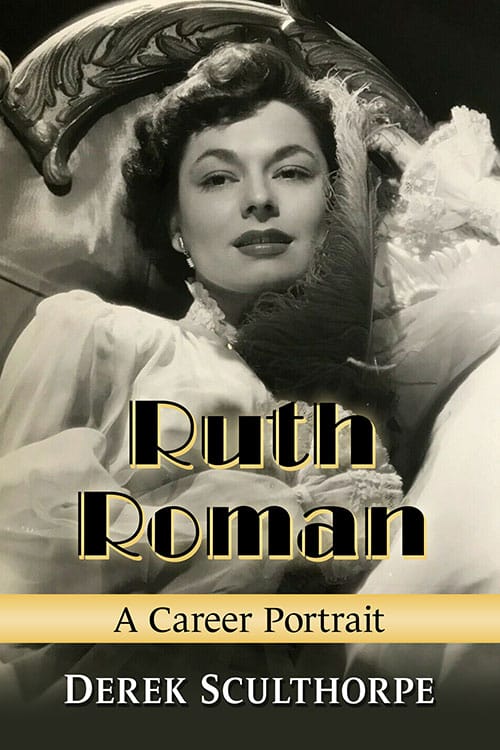
In the past few years, author Derek Sculthorpe has become the film noir fan's best friend, with his well-researched books on the likes of Edmond O'Brien, Sydney Greenstreet, and Claire Trevor. He scores again with his newest, Ruth Roman: A Career Portrait (McFarland), which shines an overdue spotlight on the talented beauty who graced the likes of The Window (1949), Lightning Strikes Twice (1951), and Hitchcock's Strangers on a Train (1951).

One of the few Golden Age actors who appeared in movies under her real name, Miss Roman originally pursued an acting career in New York City, with little success. In 1943, she relocated to Hollywood with a $100 bankroll. Not exactly an overnight success, she spent much of the next several years stuck in minor roles. But as the 1940s gave way to a new decade, her career was finally on the upswing, with an attention-getting role in Champion (1949). She was signed to a contract by Warner Brothers and given the star buildup. Though her sultry sensuality won her many fans, she fell short of becoming a major star. However, as Sculthorpe's text makes clear, Miss Roman's lengthy career in film and television amply merits a book-length study, and this is a fine one.

In the 1950s and 1960s, Miss Roman increasingly found steadier work in television. A series regular in The Long, Hot Summer (ABC, 1965-66), she also made numerous guest appearances on popular shows of that era. I was unaware of just how many classic series featured her as a guest star. Late in her career, she had recurring roles in Knots Landing and Murder, She Wrote.

Subtitled "A Career Portrait," the book's main emphasis is indeed on the actress' professional life. However, it is substantially enriched by the participation of Hollywood agent Budd Burton Moss, Miss Roman's third husband, still with us in his nineties. He gives a poignant explanation of how their marriage went awry, at a time when she felt he was making great deals for many of his clients, but not her. There's also an intriguing account of her experiences as one of the survivors of the S.S. Andrea Doria's tragic 1956 shipwreck.  

Like many of the best film books, this will leave you wanting to watch more of its subject's work. Film fans will appreciate the care and attention Derek Sculthorpe has given to an underappreciated actress who's well worth rediscovering. 

NOTE: I was provided a free copy of this book in exchange for an honest review.

Friday, February 25, 2022

Great Scott

At first glance, you might think you'd misread the title of author Derek Sculthorpe's latest, Malcolm Scott: The Woman Who Knows (BearManor Media). Delving once again into British entertainment history of the late 19th and early 20th century, Sculthorpe offers what he describes as a "portrait of a unique music hall artiste." 

In his day, Malcolm Scott was a highly successful female impersonator, who specialized in comic renditions featuring well-known personalities such as Katherine Parr, Henry VIII's last wife. Developing his own unique and acclaimed style, Scott influenced a host of performers who followed him; the author sees a certain kinship with Barry Humphries' Dame Edna. Though there is very little of Scott's work that can be seen or heard today, Sculthorpe is nonetheless successful in giving us a feel for the flavor of his comedy. He also manages to portray Scott the man and his private life, reporting the facts he skillfully uncovered but occasionally allowing us to intuit a bit more than can be definitively stated. The book offers an exhaustively researched list of professional credits.

Some readers and biographers firmly believe that a worthy book cannot be written about someone who has been dead for many years, with no survivors who can contribute to the work. Here, as in his previous writings about music hall artists, Derek Sculthorpe triumphantly proves them wrong, and in doing so makes a strong contribution to performance history that deserves to be preserved.

NOTE: I was furnished with a free copy of this book in exchange for an honest review.

Saturday, November 27, 2021

Simon in Review


Stephen Michael Shearer, author of acclaimed biographies of Hedy Lamarr and Patricia Neal, among others, recently reviewed S. Sylvan Simon, Moviemaker in his column, The Film Biographer. Here's what he had to say:

"The name of film director/producer S. Sylvan Simon is largely forgotten today for reasons which are misunderstood. Except for his last film which he produced, Born Yesterday (which won Judy Holliday a Best Actress Oscar), Simon who died in 1951, has slipped into the netherworld of forgotten film directors. And this is highly unfair, as brought out in fine detail by author David C. Tucker’s wonderfully researched biography S. SYLVAN SIMON, MOVIEMAKER: ADVENTURES WITH LUCY, RED SKELTON AND HARRY COHN IN THE GOLDEN AGE OF HOLLYWOOD.

S. Sylvan Simon began his career as a young man acting and directing in theatre. Born in 1910, he was an overachiever, and perhaps sensed early in life he would die young. By his mid-20s he was working at MGM directing first film shorts and graduating to decidedly “B” pictures including three gems with upcoming actress Lana Turner – These Glamour Girls (1939), Dancing Co-Ed (1939), and Two Girls on Broadway (1940). Assigned to films starring most of MGM’s leading character actors and second leads – Robert Young, Ann Sothern, Marjorie Main, Ann Rutherford, Wallace Beery, Frank Morgan, etc. – these minor films were highly successful and fed the coffers at Metro.

With his three popular Red Skelton pictures - Whistling in the Dark (1941), Whistling in Dixie (1942), and Whistling in Brooklyn (1943) - along with a couple of Abbott and Costello (on loan to MGM) hits Rio Rita (1942) and Abbott and Costello in Hollywood (1945), S. Sylvan Simon was considered one of the most competent and efficient directors at the studio. His films always turned profits. Signing with Columbia Pictures, Sylvan directed two more very profitable comedies with Red Skelton – The Fuller Brush Man and A Southern Yankee (both in 1948) - plus three hits starring Lucille Ball – Her Husband’s Affairs (1947) which he directed, and Miss Grant Takes Richmond (1949), and The Fuller Brush Girl (1950) - both of which he produced.

By the time he produced Born Yesterday (George Cukor directed), Simon was Vice-President in Charge of Production at Columbia Studios. He had successfully produced Lust for Gold in 1949 starring Glenn Ford and Ida Lupino and was in preparation to start From Here to Eternity when he suffered a fatal heart attack in 1951. He was just 41 years old.

So “Bravo!” to David C. Tucker for giving us S. SYLVAN SIMON, MOVIEMAKER: ADVENTURES WITH LUCY, RED SKELTON AND HARRY COHN IN THE GOLDEN AGE OF HOLLYWOOD. Each film of the director/producer is detailed in the book with fascinating and well-researched back stories. A loving tribute to a fine director...and highly recommended."

Many thanks, Stephen!

Sunday, October 31, 2021

Sand, Sun and Shrieks

It's often said that a successful book on film is one that makes you want to see the movies it discusses. But in the case of Brad Sykes' Terror in the Desert: Dark Cinema of the American Southwest (McFarland), I sometimes had a different reaction -- I was grateful to him for sitting through some truly dreadful-sounding films, so that I'll never have to. I suspect it's a lot more fun to read about them, at least in this author's hands.

That's not to say that he writes only about drek here. Quite the contrary -- he not only pinpoints a film genre that's much more prevalent than I'd ever realized, but he also shows us some of the finest examples around. Once you've accepted the idea of desert horror as a genre, it's fairly easy to think of at least a few films that might qualify -- The Hills Have Eyes (1977) and its sequels, obviously; U-Turn (1997). But you may be surprised how many others fall under the author's view here. He casts a wide net in the films he covers, going all the way back to the silent era, and up through 2016.

He identifies The Sadist (1963) as "the very first desert terror film." Though it's been memorably lampooned on TV's Mystery Science Theater 3000, Sykes makes a convincing case that it's actually a film of merit, one that works on a level beyond its tiny budget and inexperienced actors. He also wisely includes in his study made-for-TV features like Duel and Savages that clearly deserve consideration. The author's own experience as a filmmaker enriches his appreciation of the films discussed, making his commentary intelligent and knowledgeable. He tries to see what works well (and why), but when a film deserves a slam, Sykes doesn't hesitate to provide it, calling Detour (2003, not the Edgar G. Ulmer film!) "technically spotty ... abysmally acted [and] excruciatingly inane." 

This is a worthwhile and accomplished study of a film genre that has too often been overlooked.

NOTE: I was furnished a free e-copy of this book in exchange for an honest review.

Sunday, October 17, 2021

Visit to a Bygone Era

About three years ago, when I reviewed Derek Sculthorpe's book on Sydney Greenstreet, I remarked on the difficulty of painting a detailed portrait of an actor who'd been dead for some sixty years, and whose early career consisted primarily of live theater. Silly me. Little did I know how much Derek likes such a challenge. His latest, The Lost World of Music Hall: A Celebration of Ten Greats (BearManor Media) finds him profiling performers whose career achievements were often more than 100 years ago, and of whose work modern-day readers, with rare exceptions, have no first-hand memory. Does he let it daunt him? Not a bit.

Before reading this book, I knew little about the very British tradition of music halls, which flourished in an era roughly paralleling the heyday of American vaudeville houses. Here, Sculthorpe has selected ten performers -- Billy Bennett, Margaret Cooper, Bert Errol, Vivian Foster, Tom Foy, Charlie Higgins, Alfred Lester, Norman Long, Lily Morris, and Nellie Wallace -- who won acclaim with audiences of that long-gone time. They're a varied bunch -- comediennes, female impersonators, singers, pianists, and one fellow who got his laughs impersonating a vicar.  

Some of them were around long enough to make recordings, as well as appearing on radio or in the movies. But even if you can't experience them through one of those media, Sculthorpe is remarkably successful at conveying to a modern reader (and, in my case, not a fellow Brit) what audiences saw in these artists. They often persisted despite a variety of professional and personal challenges, and became favorites not only of theatregoers but even, in some cases, of the royal family. 

The book is thoroughly researched yet quite readable, and chock-full of rare illustrations that evoke the time period. It also provides excerpts from the performers' acts, and samples of the wit that audiences loved. The author doesn't bill his book as the definitive study of music halls, but as a supplement to earlier volumes, enthusiastically recommending several to the reader who wants to delve deeper. 

This book is well worth the attention of anyone who wants a look into a "lost world" that influenced the entertainment industry, and the generations of performers who followed, for years to come.

NOTE: I was furnished a free copy of this book in exchange for an honest review.

Saturday, May 29, 2021

Sunday, May 9, 2021

A Hearty Helping of Kettle Corn

Universal's long-running series of movies featuring the Kettle clan represent the epitome of unpretentious, lighthearted comedy. A thorough account of this still-beloved series comes to us in Lon and Debra Davis' Ma and Pa Kettle on Film (BearManor Media). 

This is an attractive volume, running well over 300 pages, with numerous photos and a pleasing layout. Given the subject matter, there's inevitably some overlap between this book and Michelle Vogel's biography of Marjorie Main, published about 15 years ago. But there's certainly a lot of new information here, and on the whole I found it the better-written of the two books. This is the first book I've read by authors Lon and Debra Davis, who have written extensively on motion picture comedy, and it shows them to be knowledgeable and enthusiastic.

Some readers may question the need for virtually blow-by-blow synopses of each film, as they might just prefer to watch them. But for anyone who can't get his hands on the movies, or wants to stimulate memories of funny moments via the printed page, the Davises do a good job of recounting the stories. They also provide quite a bit of behind-the-scenes information. I was interested to learn that, while the last two films (minus Percy Kilbride) aren't as well-regarded by fans, even they turned a respectable profit for the studio. The often-difficult life of author Betty MacDonald, who introduced us to the Kettles in her book The Egg and I, makes for fascinating reading as well.

The authors should be commended for taking the trouble to interview several actors who worked in the Kettle films, including Brett Halsey, who contributed the introduction. As I've mentioned before on this blog, the clock is ticking when it comes to capturing firsthand accounts of working in vintage films, and the memories of actors like Richard Eyer should be recorded for posterity.

I enjoyed the brief biographies of key players from the Kettle films, not just those who played recurring roles but "one-timers" as well. I do wish a gimlet-eyed editor had gone over these, as errors creep in occasionally, especially pertaining to television. The Dukes of Hazzard, for example, was not an ABC series (it aired on CBS), and the 1952-55 sitcom I Married Joan is misdated to 1958. But these are minor flaws in a book that, overall, is sure to please devotees of the Kettles and, perhaps, create some new ones.

NOTE: I was furnished a free copy of this book in exchange for an honest review.

Tuesday, April 13, 2021

Star in the East

Another book on Boris Karloff? Yes, and a worthy one it is, with an original angle to offer. Karloff and the East: Asian, Indian, Middle Eastern and Oceanian Characters and Subjects in His Screen Career (McFarland), by Scott Allen Nollen with Yuyun Yuningsih Nollen, covers in depth more than forty films in which Karloff or supporting actors play characters of the ethnicities specified, or the story pertains to non-Western culture. 


If this sounds like a misguided tribute to Hollywood cultural appropriation of a bygone era, it's not. As the authors note, it was long commonplace in American films for Caucasian actors to be cast as characters of any heritage, a practice that hasn't completely died out in the 21st century. Along with his undeniable talent, Karloff had certain facial features and skin pigmentation that could be emphasized with makeup or costuming to allow him to play much more than a typical English gentleman. An early chapter, "Eastern Origins," gives us a detailed examination of the family of William Henry Pratt (Karloff's birth name), and the Anglo-Indian branches of his family tree, giving insight into his unique look.

The films discussed bridge the gap between silent and sound cinema, and include several that the star's most devoted fans have likely not seen. The book's original research allows for a full-blooded discussion even of those that are presently believed to be lost. Alongside classics like The Mummy (1932), you'll find little-known early efforts like The Infidel (1922). They represent Karloff's work ranging from the 1910s to the early 1970s. To the authors' credit, the book doesn't move jerkily from one "Eastern" film to the next, omitting the connecting threads; it can also be profitably read as an overview of Karloff's entire career, which Scott Allen Nollen knows probably as well as anyone can.

For each film, the Nollens outline its story, and an account of its production, but supplement that with an assessment of how elements of Eastern culture are depicted. This is particularly interesting when reading about films like Voodoo Island (1957), which has been covered by several good writers, but never with the added context of how it presents religious and spiritual beliefs in the Hawaiian islands (clue: not well!). The result may even damn it to more critical brickbats than it customarily receives. As a B-movie (and Poverty Row) buff, I enjoyed the discussion of Monogram's Mr. Wong series, a welcome gig for Karloff during the turn away from horror films in the mid- to late 1930s. These are often dismissed as cheap potboilers, with little more than Karloff's paycheck and presence to justify them. But the authors approach these films as they do all covered in this volume, with minds open, not parroting earlier appraisals but making a fair assessment of what they have to offer.

The book's illustrations are stunning: vintage lobby cards, film stills, one-of-a-kind photos from Karloff's personal collection, and correspondence received from the likes of Vincent Price during Nollen's decades-long research into the star. 

The brand of in-depth scholarship on display in this massive volume is becoming a bit of an endangered species, and the Nollens are to be congratulated for a strong contribution to film studies in general, and specifically the career of one of Hollywood's most enduring stars.

NOTE: I was furnished an e-copy of this book in exchange for an honest review.

Sunday, March 28, 2021

Mr. Mason Remembered


How many performers whose careers began before the advent of motion pictures have had their achievements lost to history? Yes, we remember a select few, but a lack of documentation, and short memories, put the kibosh on too many others.

That's no longer the case for comic actor Dan Mason (1853-1929), thanks to Joseph P. Eckhardt's latest book. The author was granted access to a rich array of photographs, scripts, and playbills, as well as Mason's  uncompleted memoir. With that framework embellished by Eckhardt's exhaustive research, the result is Dan Mason: From Vaudeville to Broadway to the Silent Screen (McFarland).

In many ways, Mason's career illustrates the sweeping changes in the entertainment industry between the late 19th and early 20th centuries. We follow along as Mason, a high school dropout, finds his comedic gifts adaptable to variety shows, vaudeville, Broadway, and finally silent movies. Fans of early motion picture comedy will enjoy reading about Mason's work in the Toonerville Trolley two-reelers of the early 1920s. Had he lived a year or two longer, he likely would have sound pictures on his resume as well.

Naturally, there are questions that cannot be fully answered, 100 to 150 years later. When complete details are elusive, Eckhardt is honest enough to say so. Nonetheless, the author gives us an impressively full-bodied portrait of Mason, the man and the performer. There were frequently stresses and challenges in his life, among them a brief early marriage, the death of his first two children before they reached adulthood, and recurring money problems. Not only was he devoted to his daughter Anna, known as Nan, but he also took a young actress, Wilna Hervey, under his wing. Decades ahead of his time, he was completely supportive when the two women became romantically involved, fully embracing them as a loving couple.

Cliched though it might seem, there's a poignancy about a performer who carefully saves yellowing newspaper clippings and memorabilia over a period of some years, clearly hoping that someone, sometime, will care. Luckily for Dan Mason, Joseph P. Eckhardt came along and understood the worth of what he found. Readers will surely do likewise.

NOTE: I was furnished with a free e-copy of this book in exchange for an honest review.

Sunday, March 21, 2021

Page from History

Anita Page (1910-2008) was a blonde beauty who attained her childhood dream of becoming an actress in Hollywood's early days. Though circumstances cut her starring career short, she's still remembered and admired by many film fans. Anita Page: A Career Chronicle and Biography (McFarland) does a fine job of telling her story.

Co-author Allan R. Ellenberger is a highly respected film biographer whose earlier books on Margaret O'Brien and Miriam Hopkins I have enjoyed. His interviews with Miss Page over some years are at the heart of the book. He teams with Robert Murdoch Paton, a longtime fan and collector of memorabilia from Miss Page's life and career.  Their book offers more than 75 photographs, including rare family snapshots and cleanly reproduced film stills, that cover the entirety of her long life.

Signed to an MGM contract at the age of 17, Anita Pomares, rechristened "Page," soon advanced to lead roles, becoming a popular screen presence in films such as Our Dancing Daughters (1928) and The Broadway Melody (1929). She was named a WAMPAS Baby Star, alongside the likes of Jean Arthur and Loretta Young. Miss Page's career took an abrupt downward turn in the early 1930s, after a falling-out with studio boss Louis B. Mayer. Following her marriage to a military man, she retired from the screen, raising two daughters and having few regrets about leaving Hollywood behind. Late in life, in her eighties, she enjoyed a return to acting in indie films, and attracted a new generation of devotees.

The book is divided into two main sections, with a biography being followed by an extensively annotated filmography. It is a rare privilege in the 21st century to learn so much about an actress whose career dates back nearly 100 years, drawing on her first-hand accounts of films that encompass both the silent and sound eras. Though fans of Anita Page will certainly want to snap this up, the book will also appeal to followers of motion picture history in general, especially of the silent era. 

When reminiscing, Miss Page projects just the sort of aura we expect of a silent movie star -- just a bit high-maintenance, and not overly burdened with modesty, which only makes the book more fun. Her recollections of her film colleagues are candid and opinionated, with a dash of dish. Of co-star Clark Gable, she says, "I thought he was charming ... but he just wasn't my type," while she confides that she wasn't impressed with Joan Crawford's acting ability. ("She didn't seem to be able, in my opinion, to hold an emotional moment.") Other famous names who feature prominently in Anita Page's story are Lon Chaney (Sr.), Buster Keaton, and Jean Harlow, just to name a few.

It's still early in the year, but this bids fair to be one of classic film buffs' most noteworthy books of 2021.

NOTE: I was provided a free e-copy of this book in exchange for an honest review.

Thursday, February 11, 2021

Words from Mr. Watson

You'd be hard-pressed to find many people who know more about the peerless Lucille Ball than Tom Watson. Longtime president of the We Love Lucy fan club, he's also the co-author of Loving Lucy: An Illustrated Tribute to Lucille Ball. Since Lucy looms large in my newly released book S. Sylvan Simon, Moviemaker: Adventures with Lucy, Red Skelton, and Harry Cohn in the Golden Age of Hollywood, I invited Tom to give it a look.

Here's what he had to say:

The newest book on my Lucy Bookshelf is “S. Sylvan Simon, Moviemaker” (subtitled “Adventures with Lucy, Red Skelton and Harry Cohn in the Golden Age of Hollywood”), by author/historian David C. Tucker. I should emphasize the word “historian,” for not only is Mr. Tucker the author of at least 8 other show biz centered books, but this one (like the rest) is published by McFarland & Company, which tends to take a more erudite approach to things: most of their books tend to eschew the “Lucy ran to the bedroom in tears” anecdotes in favor of “just the facts, ma’am.” But (if I can mix in yet another Hollywood metaphor) there are a few “who shot who in the Embarcadero in August, 1879” stories just for fun -- when they reflect on the person or movie being discussed.

 "Her Husband's Affairs," with
Lucy and Franchot Tone.
The book is divided into two main parts: a names, date, places biography, chronicling Simon’s life and career, and an extensive filmography, that lists all of the pictures on which Simon worked, providing not only the official credits for each of the films, but a synopsis of the story, reviews, and comments.

Tucker has done a wonderful job here, shining some light on a little known writer-director-producer who made a profound contribution to the screen careers of both Lucille Ball and Red Skelton (and countless others). At MGM, he directed Skelton in such comedies as “Whistling in the Dark,” and it’s sequels, “Whistling in Dixie” and "Whistling in Brooklyn,” and directed Lucy in the cameo appearance she made in “Abbott and Costello in Hollywood.” Moving over to Columbia where he became a producer and soon took over as head of production, Simon starred Red in “The Fuller Brush Man,” directed Lucy in “Her Husband’s Affairs” and cast her in “Miss Grant Takes Richmond” and “The Fuller Brush Girl” (a follow-up to the Skelton hit).

As Tucker points out, the films Lucy made with Simon both showcased and helped advance her comedic abilities – setting her in motion for the stellar career in television that soon followed. Sadly, Simon himself did not live to see his star’s greatest success – he died in May of 1951 at the age of 41. Here, at last, is a fine chronicle of his life and career.

Thanks, Tom!