Showing posts with label I Love Lucy. Show all posts

Friday, October 12, 2018

Not Just Lucy's Babysitter

Elizabeth Patterson (r.), with Vivian Vance, on I Love Lucy. 
What I Love Lucy fan doesn't have a soft spot for the Ricardos' charming neighbor, and frequent babysitter, Mrs. Mathilda Trumbull? It's a credit to actress Elizabeth Patterson that she made such an impression -- though frequently mentioned, Mrs. Trumbull actually appeared in only ten episodes. (Before being cast in that role, Miss Patterson played a different character in the first-season segment "The Marriage License.")

One reason we didn't see more of Mrs. Trumbull was that the actress, despite her advancing years, was still in demand elsewhere. In December 1953, syndicated columnist Erskine Johnson reported, "Lucy and Desi will have to find themselves a new baby sitter," as the 78-year-old Patterson was Broadway bound in a new show. Though the play, His and Hers, starring Celeste Holm, ran only about two months, Mrs. Trumbull would be absent from Lucy until the fall of 1954, when she turned up in "The Business Manager." In that memorable episode, Lucy's note about Mrs. Trumbull's grocery order ("buy can All Pet") would cause a confused Ricky to believe his wife was playing the stock market.

Some fifteen years before she joined the I Love Lucy cast, Miss Patterson told an interviewer, "Life and fame for an actress may just begin as she reaches her fortieth year. If she can hold on in Hollywood until she's fifty, she no doubt will have a job as long as her health lasts." Indeed, she continued to act until just a few years prior to her death in 1966, at the age of 90. Her long and accomplished life might inspire all of us to keep pursuing our dreams as long as we're able.

Thursday, October 15, 2015

Happy Anniversary, Lucy!

The early days of a TV empire.
Hard to believe it's time to commemorate the 64th anniversary of the classic of all TV classics, I Love Lucy. But in fact American audiences were introduced to Lucy, Ricky, Ethel, and Fred on October 15, 1951, when "The Girls Want to Go to a Nightclub" aired on CBS. Although not the first episode filmed, it was chosen as the best one to help the show find its audience.

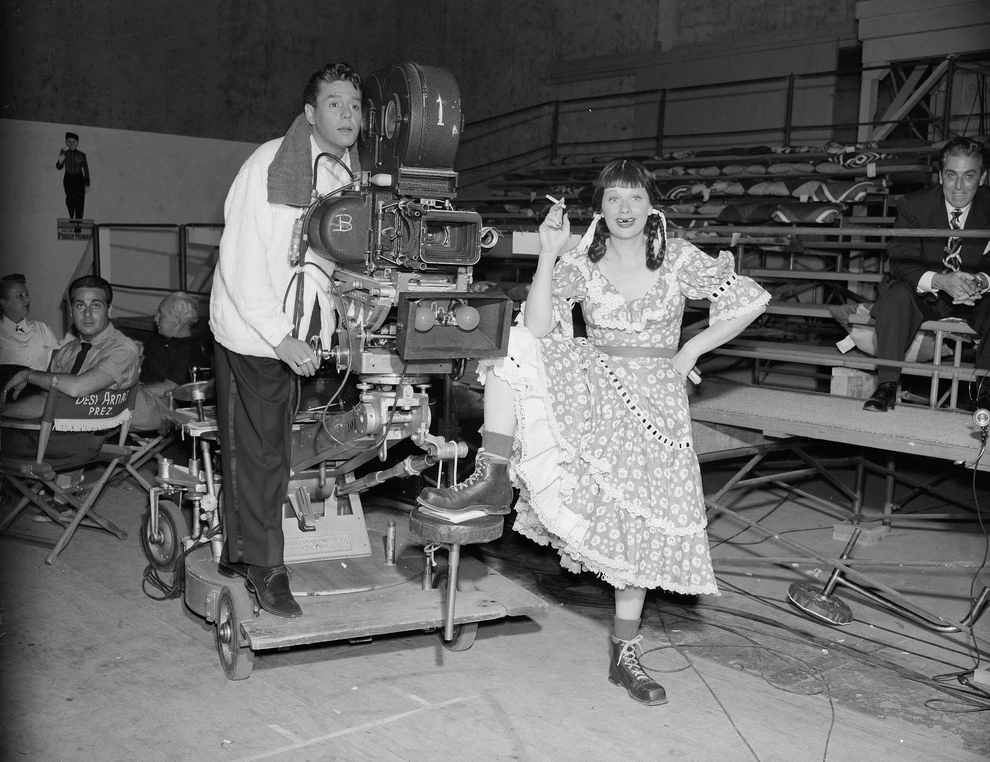
Fittingly, anniversaries were the topic of that premiere episode, as the wives clash with their husbands on how to observe the Mertzes' 18 years of marriage. When the girls refuse to celebrate at the boxing ring, Lucy threatens to find escorts who will take her and Ethel somewhere more appealing. Ricky calls her bluff, and says he and Fred will also find dates for the evening. Thanks to some typical Lucy Ricardo scheming, the guys end up with their own wives in disguise, as a hillbilly gal and her Maw.

Not all critics warmed to this new situation comedy, but audiences embraced Lucy and her companions from Day One, and there's seemingly no end in sight to that love affair. Not all TV shows from the 1950s play well today, but you're a stronger character than I am if you can watch an episode of I Love Lucy sixty-odd years later and not crack a smile.

Saturday, August 1, 2015

Cold Comfort


Ugh. It's early August, and I am tired of being hot. Fall is my favorite season, and right now it seems too far away. So to help myself, and others, "think cool," here's the coldest classic TV picture I could find. This is, of course, from "The Freezer," a popular first-season episode of I Love Lucy, first telecast on April 28, 1952. Think I'll go watch it now, in hopes of picking up just a little of the chill from the Ricardos' new walk-in freezer.

Popsicle, anyone?

Monday, July 27, 2015

Stump the Hardcore Lucy Fan? It Can't Be Done!

I've mentioned before that I do a daily trivia challenge on Facebook's Classic TV Lovers' Haven page. Although I try to cover a variety of shows and stars in my questions, about once a week or so I find myself asking about I Love Lucy. More than any other show included, this is the one that classic TV fans know backwards and forwards.

With 10,000 members in the group, it usually takes no more than five minutes -- often less -- for someone to correctly answer a Lucy query. These are a few I've tried recently:


1.  What's the name of the movie for which Lucy and Ethel perform a publicity stunt (seen above) atop the Empire State Building?

2.  According to Lucy Ricardo, whose personal habits include "scratching himself, and peeling bananas with his feet"?

3.  After Ricky Ricardo refuses to appear in his wife's play A Tree Grows in Havana, what does Lucy retitle her drama?

4.  What did Ricky Ricardo do after reading - and misunderstanding - Lucy's note that read "BUY CAN ALL PET"?

If you're interested enough to read this blog, I'm guessing that you won't have much trouble answering these either. But if you're stumped, drop me a note. It's always nice to hear from a fellow Lucy fanatic.

Sunday, April 12, 2015

Go West, Miss Vance

Here's something you don't see every day -- TV's Ethel Mertz on the set of a Western drama. In 1959, with the cast of I Love Lucy playing those characters only in occasional hour-long episodes, Vivian Vance was ready for an opportunity to broaden her horizons. She was therefore pleased by the booking to play a guest role on NBC's The Deputy, which starred Allen Case (above) as the title character, Clay McCord.

As a regular player on one of TV's first top-rated shows, Miss Vance was likely unprepared for the level of fame that weekly coast-to-coast exposure could bring to an actor. While the professional success was gratifying, she feared that her years as frumpy, plain-spoken Ethel Mertz had so overshadowed her previous achievements in films and theater that she would be irrevocably typecast. As she told a reporter while working on The Deputy, "When my friends begin calling me Ethel instead of Vivian, it is time to make a radical change in style."

Unfortunately, her efforts to change things up met with limited success. Her friend Desi Arnaz cast her in a 1960 sitcom pilot, "Guestward Ho," but the network insisted on a different leading lady. So, with some hesitation, she accepted a lucrative offer in 1962 to be Lucille Ball's co-star on The Lucy Show. As it turned out, she never quite escaped the enduring identification as Lucy's sidekick. While she's fondly remembered for those performances, we'll never know what other types of roles she might have played.

Tuesday, March 31, 2015

Peggy Rea: From Secretary to Supporting Player

"I'm just an incurable ham," said Peggy Jane Rea of her lengthy career as a film and television actress. Born March 31, 1921, Miss Rea originally worked as a secretary, getting a taste of show business with jobs at MGM, a New York advertising agency, and the production office of TV's Gunsmoke. 

Although she can be seen in early shows like I Love Lucy, it wasn't until the early 1960s that she gave up her day gigs and devoted herself fully to being a character actress. Prior to that, when she served as secretary to producer Arthur Freed at MGM, she was prone to slip out occasionally to have studio costume and makeup artists transform her into whatever character she hoped to play next, whether it be a prim schoolteacher or a little old lady. As she told syndicated columnist Erskine Johnson, Freed indulged her, and "joked about having a secretary with a thousand faces."

Later years brought her prominent roles such as Rose Burton on The Waltons, Lulu Hogg on The Dukes of Hazzard, and Jean Kelly on Grace Under Fire. Miss Rea died on February 5, 2011, at the age of 89. But today, on her birthday, let's take a moment and remember this lady who brought so many sharply etched characterizations to life.

Thursday, February 26, 2015

Mr. Frawley's Birthday

Happy birthday to that grumpy old skinflint, William Frawley, born February 26, 1887. In actuality, of course, it's his iconic character Fred Mertz who I'm describing, but many who worked with him said there wasn't a great deal of difference. One of them was Lucille Ball, who said fondly, "Bill Frawley was Fred Mertz. Period."

He parlayed that memorable face and voice into a long and successful career as a movie character actor before making the switch to TV with I Love Lucy in 1951. From that point on, he seldom stopped working, going on in the 1960s to a co-starring role in My Three Sons. Declining health forced him into retirement a year or so before his death in 1966.

In honor of his birthday, I'm hearing his gravelly voice in my head, singing a little number from a favorite Lucy episode. "Too Many Crooks," finds the brownstone where the Mertzes and the Ricardos live all atwitter over the nocturnal visits of a cat burglar. When Ethel insists that Fred change the locks on all the apartments, and he is equally insistent that they can't afford it, she offers to pay for the hardware herself. To do so, she's dipping into the money she was saving for his birthday present, leaving a resigned Fred to make his exit singing a little ditty to the tune of "Happy Birthday": "New door locks for Fred ... new door locks for Fred..."

If it doesn't sound that hilarious on paper (or on a screen), picture it sung by Frawley in that inimitable voice, and surely that will make you smile.

Sunday, November 23, 2014

(Mostly) Silent Star

Perhaps this should be a blog entry with only pictures, no words, to honor the memory of Harpo Marx, born (with the given name Adolph) on this date in 1888. His inimitable career in comedy drew almost entirely on his ability to mine laughs from facial expressions, sight gags, pantomime, and other nonverbal expressions. What little his characters had to say was often conveyed with the toot of a horn he carried almost everywhere, although most Marx Brothers movies also made room for at least one musical number performed on the harp that gave this great comedian his stage name.

A popular comedy team on stage and in movies, the Marx Brothers began to go their separate ways professionally in the late 1940s. Though Harpo's comedy was obviously ill-suited to radio, he made occasional television appearances in the 1950s and early 1960s, notably a classic episode of I Love Lucy (above) in which he and Lucille Ball play lookalike versions of his iconic character. He also appeared on episodes of The DuPont Show of the Week, The Martha Raye Show, Candid Camera, and his brother Groucho's popular quiz show You Bet Your Life. In 1961, he proved more eloquent than his comedic characters when he published a fascinating autobiography, Harpo Speaks.

Harpo Marx died on September 28, 1964, a few weeks short of his 76th birthday. He was survived by his wife of 28 years, former actress Susan Fleming, as well as by the four children they adopted. You can learn much, much more about this gifted comedian by visiting Harpo's Place, the website created and administered by his son Bill. 

Tuesday, November 18, 2014

When Rhoda Met Ethel

Valerie Harper and Vivian Vance on Rhoda
Here's a rare opportunity to see, side-by-side, the actresses who played two of classic TV's best known sitcom sidekicks. The picture is from Vivian Vance's 1975 guest appearance on Rhoda. (Adding to the nostalgic ambiance was Vivian's TV husband, played by David White of Bewitched).

As Valerie Harper admitted, "Vivian was an idol of mine and it was wonderful to see her work ... Her talent contributed to the atmosphere to write for a character like Rhoda ... Without Lucy and Ethel, they wouldn't have wanted Mary and Rhoda."

You can read about this classic episode, and Vance's remarkable career, in Frank Castelluccio and Alvin Walker's book The Other Side of Ethel Mertz: The Life Story of Vivian Vance (Knowledge, Ideas & Trends, 1998).

Wednesday, August 6, 2014

Lucy at 103

Would we forget Lucille Ball's birthday around here? Well, of course not! So put on one of Mrs. Trumbull's party hats and light a candle in honor of this iconic comedy star, born August 6, 1911. Because if you don't, she'll be forced to join the Friends of the Friendless, and won't you feel guilty?

Saturday, August 2, 2014

The Man Who Didn't Love "Lucy"

The late John Crosby (1912-1991) was widely considered one of the most knowledgeable and respected TV critics, his newspaper column syndicated nationwide in the 1950s and beyond. His name came up often as I researched five books about show business history. So I was interested by his November 2, 1951 column, in which he expressed a less-than-delighted reaction to a new CBS television series called I Love Lucy.

Lucy gets some marital advice in "Be a Pal."
Lucy had aired only three episodes ("The Girls Want to Go to a Nightclub", "Be a Pal", and "The Diet") when Crosby called Lucille Ball's now-classic series "a terrible waste of her talents and her husband's." In Crosby's view, the show was typical of much Hollywood output in the early days of TV, drawing on shopworn ideas about married life carried over from radio: "The endless cliches into which these people are thrust, and what I'm afraid is the spirit of contempt or, at very least indifference, toward television which seems to imbue the actors, robs them of a great deal of their personality and of their appeal." While acknowledging that the show was "very competently put together" and "written almost too professionally," Crosby found it an inferior offering.

Happily for Lucy lovers, Crosby did come around somewhat; a year or so later, he wrote, "At its best, the show has some of the manic informality and improvisation of the early silent film comedies." Of its star, he said with unqualified admiration, "She's a really great clown." And if, overall, he still wasn't the show's most uncritical fan, he wrote with a certain air of resignation, "Who am I to argue with 12,000,000 families?"

Monday, June 16, 2014

Happy Birthday, Margie!

In the heyday of classic TV, the month of June was usually marked by the arrival of summer replacement shows. Many would run a few weeks between June and August, never to be seen again. But others developed into popular hits that found a home on the regular year-round schedule.

One of my favorite summer replacement shows was My Little Margie, starring Gale Storm and Charles Farrell, which premiered (get ready!) 62 years ago today, on June 16, 1952. Critical response to the show was mixed, not helped by the fact that it was CBS' summer replacement for I Love Lucy. Lucy's first, groundbreaking season, when it became TV's top-rated show, set the bar high for whatever took its place, even temporarily. But if critics weren't enamored, viewers were. As Miss Storm herself would later say of her show, "Nobody likes it but the people." Given its popularity, the show had no difficulty lining up a sponsor for fall; it ultimately ran for three years, and produced 126 episodes. Once My Little Margie had run its course, Gale Storm returned to TV in 1956 for The Gale Storm Show: Oh, Susanna!, which lasted from 1956 to 1960.

Some years ago, when I was writing The Women Who Made Television Funny: Ten Stars from 1950s Sitcoms, I had the privilege of doing two telephone interviews with Miss Storm. She was lively, funny, and generous with her time. It was easy to see how she had charmed movie, television, and theater audiences over the course of her long career -- as she still does today, whenever we have the chance to enjoy her work.

Friday, April 11, 2014

Many Unhappy Returns

Did your taxes weeks ago, right? Already have your refund check banked, or even spent? Then please have some sympathy for those classic TV characters who face the age-old suburban tradition of the yearly income tax deadline.

That's a plotline that's surfaced on many of our favorite comedies over the years, from The George Burns and Gracie Allen Show (would you want to be the assessor interpreting Gracie's record-keeping?) to Sanford and Son (whose star Redd Foxx went more than a few rounds with the IRS in real life). And you know any attempt to part Jack Benny from his money has to be a battle royale.

My favorite such episode, though, may be I Dream of Jeannie's "My Master, The Tycoon," with Paul Lynde as revenue collector Henry Huggins. Not knowing who he is, Jeannie takes offense when the visitor makes some cutting remarks about Tony's house in typical Lynde style. Of course, for a genie, it takes only a blink to spruce up the place with a few priceless works of art. Now if Tony can just figure out how to pay his tax bill!

In case you're wondering why you never saw an income tax story on I Love Lucy, it's because star/executive producer Desi Arnaz vetoed it. Act Two of 1953's "Lucy Tells the Truth" was written to contain a plot twist in which Lucy gets even with Ricky by being way too candid about his tax deductions. Arnaz, proud of his hard-won American citizenship (and probably also aware that Latino viewers saw his character as a role model) protested that Ricky would never cheat the government, and the script had to be changed.

By the way, now that I've written five books about show biz history, do you think I could deduct my TV set as a business expense?

Tuesday, April 8, 2014

Appointment with Dr. Bellows

Few television actors have ever been more closely identified with one role than the late Hayden Rorke (1910-1987) was with befuddled psychiatrist Dr. Alfred Bellows on I Dream of Jeannie. Not to say that this fine character actor didn't have other credits on his resume -- quite the contrary. Originally a stage actor, he went on to perform in numerous films, including such well-remembered features as Pillow Talk, Father's Little Dividend, and Spencer's Mountain. You can also see him on I Love Lucy as a new neighbor who arouses the suspicion of Lucy and Ethel, making them fear that he and his wife plan to overthrow the country.

But it was as Dr. Bellows, the man who tried in vain for five seasons to figure out what made Major Anthony Nelson tick, that he became a recognizable face to TV fans. Just as some viewers seemed to honestly believe that those castaways were stranded on Gilligan's Island, others sought out the actor who played Dr. Bellows for psychiatric help. "I received one letter from a lady in Portland, Oregon," Rorke recalled in a 1967 interview, "who wrote, 'If I should ever need a psychiatrist I shall send you the money, since I can't leave here, and you'll have to come to me.' Another person wrote me three or four times, convinced that if she could meet me, I could solve her problems." As a longtime viewer, I liked that the final episode filmed allowed Dr. Bellows to learn Tony's secret at last, even if it was only in a dream sequence, alas.

Aside from Jeannie, Hayden Rorke was featured in two previous sitcoms, Mr. Adams and Eve (1957-58) and No Time for Sergeants (1964-65). He came out of semi-retirement in the 1980s to reprise his role as Dr. Bellows in the TV-movie reunion, I Dream of Jeannie...Fifteen Years Later. He died of cancer at the age of 76, having survived his longtime partner, director Justus Addiss.

While I'm not sure I would have sought out Dr. Alfred Bellows for therapeutic treatment, I still smile when I think of the gifted actor who played him, and the many hours of entertainment he gave us.

Saturday, March 1, 2014

The Ides of Hal March

What better way to welcome the month of March than by celebrating the life and career of actor, comedian, and TV game show host Hal March (1920-1970)? Best-
remembered as host of the popular 1950s game show The $64,000 Question, March also played Harry Morton in early TV episodes of The George Burns and Gracie Allen Show, and starred on Broadway in Come Blow Your Horn. Fans of I Love Lucy know him for his guest appearances as Eddie Grant, a lecherous salesman who tries to put the moves on Lucy Ricardo in "Lucy is Matchmaker", and as the phony doctor who diagnoses her with "the gobloots" in "Lucy Fakes Illness."

By 1957, March was reported to be receiving bales of fan mail and earning a sizable paycheck as host of Question, which CBS expected to run for at least five more years. Unfortunately, the game show scandals of the late 1950s soon brought the show to its knees, and did March's career some serious harm, although he personally was not implicated in wrongdoing. He continued to work as an actor throughout the 1960s, and was making a comeback with another game show, It's Your Bet, when he was diagnosed with terminal lung cancer. He died on January 19, 1970 at the age of 49, leaving behind a wife and five children.

You can read more about this engaging favorite from TV's youth at The Game Show Fix.

Monday, January 27, 2014

Our Special Guest Tonight

That Girl: Marlo meets the Merm.
For some viewers, it's a special treat that makes an otherwise run-of-the-mill sitcom episode stand out. For others, it's a sure sign that the show's writers are fresh out of story ideas. I'm talking about the use of celebrity guest stars in your favorite sitcom.

The idea isn't a new one; radio stars like Jack Benny and Burns and Allen regularly welcomed guest stars at least back to the 1940s. In the mid-1950s, the I Love Lucy writers had the inspired notion to send Lucy, Ricky, and the Mertzes to Hollywood, resulting in unforgettable scenes like Lucy's disastrous meeting with William Holden at the Hollywood Brown Derby, or a classic pantomime with Harpo Marx. Surely no one will ever top Lucy's record for meeting (and annoying!) celebrities in her four weekly series.

Obviously, some shows lend themselves to the concept better than others. Since That Girl told the story of an aspiring actress building a career in New York, it was easy enough to work in guests such as the queen of Broadway musical comedy, Ethel Merman (above). It was a little tougher to logically place Hollywood stars in Hooterville, and you would have thought being stranded on an "uncharted isle" would have kept the cast of Gilligan's Island pretty isolated. That didn't stop Zsa Zsa Gabor, Phil Silvers, and a few others from stopping by, though.

Do you have a favorite sitcom episode featuring a big-name guest star? Feel free to post your choice in the comments below.